Folsom's 93

The Lives and Crimes of Folsom Prison's Executed Men


Leave a comment

Passive Voice: It’s Not Just a Misdemeanor Anymore

It’s a felony, but I’ll get to that.

Twenty-seven judged entries are in the mail. I did my best to crush the dreams of several writers.  Mmuuhahah! (evil sinister laugh) Okay, of course I hope I didn’t do that. In fact, I like to think I offered constructive criticism while pointing out things they did well.

As writers, I believe we need to learn from everything we read and admit (even if it’s only to ourselves) what our shortcomings are when it comes to our own writing. Believe me, I’m no grammar maven. In fact, I’ve probably recently submitted less-than-stellar work containing errors and rogue commas. (I am after all, a recovering Comma Fairy who used to sprinkle my work with magic comma dust, letting them fall where they may).

Judging these entries for the Pacific Northwest Writers Conference proved to be a fantastic learning experience for me. It made me a better writer (at least that’s what I keep telling myself). So here’s what I (think) I learned:

Writing Mechanics are a lost art—apparently. Of the 10 elements to address in each entry, I’d say writers struggled the most in the area of mechanics (sentence structure, spelling, punctuation, formatting, verb tense consistency, and typos). My biggest pet peeve: Passive Voice. Sure, “was” has its place:

“It was a dark and stormy night . . .”   “T’was the night before Christmas . . .”   “It was the best of times, it was the worst . . .” (Oh, geez. There’s two of them)!

Don’t be a victim of passive language. Protect yourself with active verbs.

For many of the entries, I found it extremely difficult to see the story behind the constant ill-formatting, typos, and improper punctuation. In fact, it appeared many entrants devoted very little time and effort to the mechanics of  writing by using strange and inconsistent dashes, ellipses, and indentations. (If you’re going to misuse them, at least misuse them consistently). For some, I suggested a Comma Cleanse. Guaranteed good karma for the writers’ soul. One person misspelled their main character’s name three times! Another left a blank page in the middle of the submission and another page printed crooked, going off the edge of the paper.

Poor mechanics can kill an otherwise good submission and distract the reader from the story. So don’t rely on your fabulous story to save your butt.  After you think you’ve finished typing up your submission, take 1-2 days and focus ONLY on mechanics. Give it to someone else with instructions to only look for grammatical errors. Doing that can save your butt.

Other stuff I learned:

  • When submitting a one-page synopsis, use the whole page! Also, don’t assume the judge reads the synopsis first by thinking, “Hey, they’ll get it when they read the synopsis . . .” Uh, no. I read the synopses last because I wanted to have the same experience their target reader would have. Make the tone, mood, time, and setting clear, as well as who the central character is.
  • I suggest never ending your submission with half a sentence. Just because you have a page limit, doesn’t mean you print out just those pages and call it good. Tidy it up; don’t leave a sentence hanging.
  • Thinking about writing a 13-page prologue? Please don’t.

And last . . .

  • I’m not perfect! I know, hard to believe, huh? I learned it’s easier to point out flaws in others writer’s work than in my own. We can all be like that to a point, right? It forced me to see my own writing flaws and hopefully, correct them. Hmmm . . . I think I might be getting the hang of this writing thing.

Leave a comment

. . . Seldom is heard a discouraging word . . .

Isn’t that how the song goes? “Oh, home on the range . . . la, la, la . . . where seldom is heard a discouraging word . . .” I thought it was “encouraging word” therefore providing some sense to this post—stay with me—but I looked it up and it is indeed “discouraging.”  And I don’t want to be discouraging. (Then I realized what a downer if the song said seldom is heard an encouraging word . . .) Ok, anyway . . .

I’m talking about judging entries for a literary contest. I want to be encouraging, but what do I do when those types of words escape me? When I can’t think of an encouraging thing to say except, “Ah, keep at it,” or “Good use of the word the.”

image source

What if I find an entry offensive? Both in content and in language? Now, some people might conclude—if they didn’t know better—that swashbuckling sailors or a pack of wild truck drivers raised me (sorry, Mom) but even the product of those upbringings can easily get offended. Even me. I won’t repeat what the entry-in-question contained, but it did in fact leave me speechless, which rarely happens.

Not every submission has been bad. For every four entries, there is one that earns a double take and leaves me wanting more pages. These, I jot down on a piece of paper for my own use; one to look back on when the results of the contest are announced. I realize that this endeavor; this process of printing out your proverbial baby and sending it off into the unknown to unknown judges for the purpose of being well . . . judged, can be a very scary thing. Believe me, I know. I’ve done it twice. The second time resulted in a finalist position, but that was all. Someone else’s baby fared better.

My motto as I read through these entries: Not a Discouraging Word. In the meantime, I’m looking for sage advice here, folks.

Have you ever judged a literary contest? What did you learn? What would you have done differently? Tell me, O’ Wise Ones . . .


Leave a comment

The Punctilious Proposal

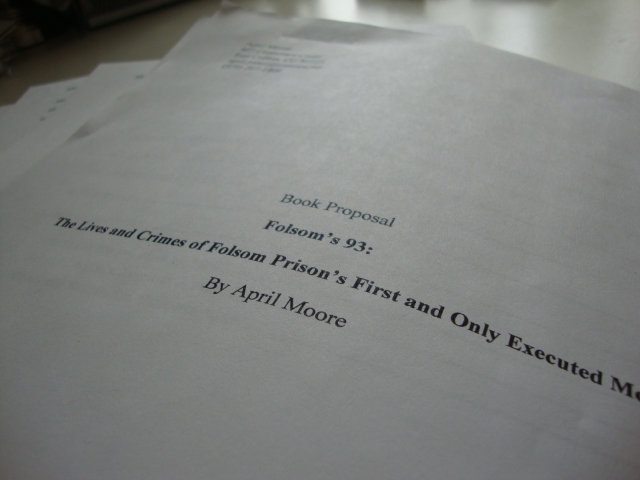
Ask most writers and they’ll tell you that writing a book proposal ranks up there with having a root canal. They run in the same circles with synopses and query letters, also likened to painful dental procedures.  There are endless how-to books on writing book proposals, all varying in some way or another, all insisting their format is the best one to follow. The anxiety of picking the correct format could easily be compared to picking the right door on Let’s Make a Deal.

I’ve been told by some in my critique group that a book proposal is unnecessary for Folsom’s 93, as it is creative nonfiction. I have also been informed of the converse; all nonfiction requires a proposal—before the book is even finished. What is a writer to do?!

Well, I wrote one. And I have rewritten the damn thing more times than I care to share, over the course of a year. I’ve added to it, deleted stuff, changed it, altered it, and contemplated burning it. But I know like a phoenix, it would continue to rise from the ashes . . . and haunt me until I got it right.

On March 11th and 12th, the completed and newly revised proposal will make an appearance at the annual Northern Colorado Writers Conference where I will be pitching it to an agent. As a member of the NCW and part of the conference’s creative team, I will have lots of other things to keep my mind off of the proposal. Informative and creative workshops await me, including How to Build an Effective Platform by the very agent I will be pitching to.

In the meantime, wish me luck and for my fellow proposal writers, I feel your pain.


Leave a comment

No Excuses . . . Time to Finish!

Have you ever seen such a beautiful stack of documents? That’s about 620 pages. 620 pages from the California State Archives that arrived today. When the doorbell rang, I just knew. I glanced out the window and saw a hint of a white truck and I just knew.  The FedEx man could clearly see my unbridled excitement and probably thought I was about to kiss him. Maybe that happens often with these guys, but I only had eyes for the box I was holding.

When my husband came out of his office and saw my obvious glee, I told him to guess what I got. “Cheese?” Huh? Ok, the only other time I got that excited over a package was when I ordered some nut cheeses from some place on the east coast and apparently, that memory stuck with him. Once we got past the cheese thing, he remarked. “You’re gonna be busy this weekend.” Darn tootin’. Wish me luck.