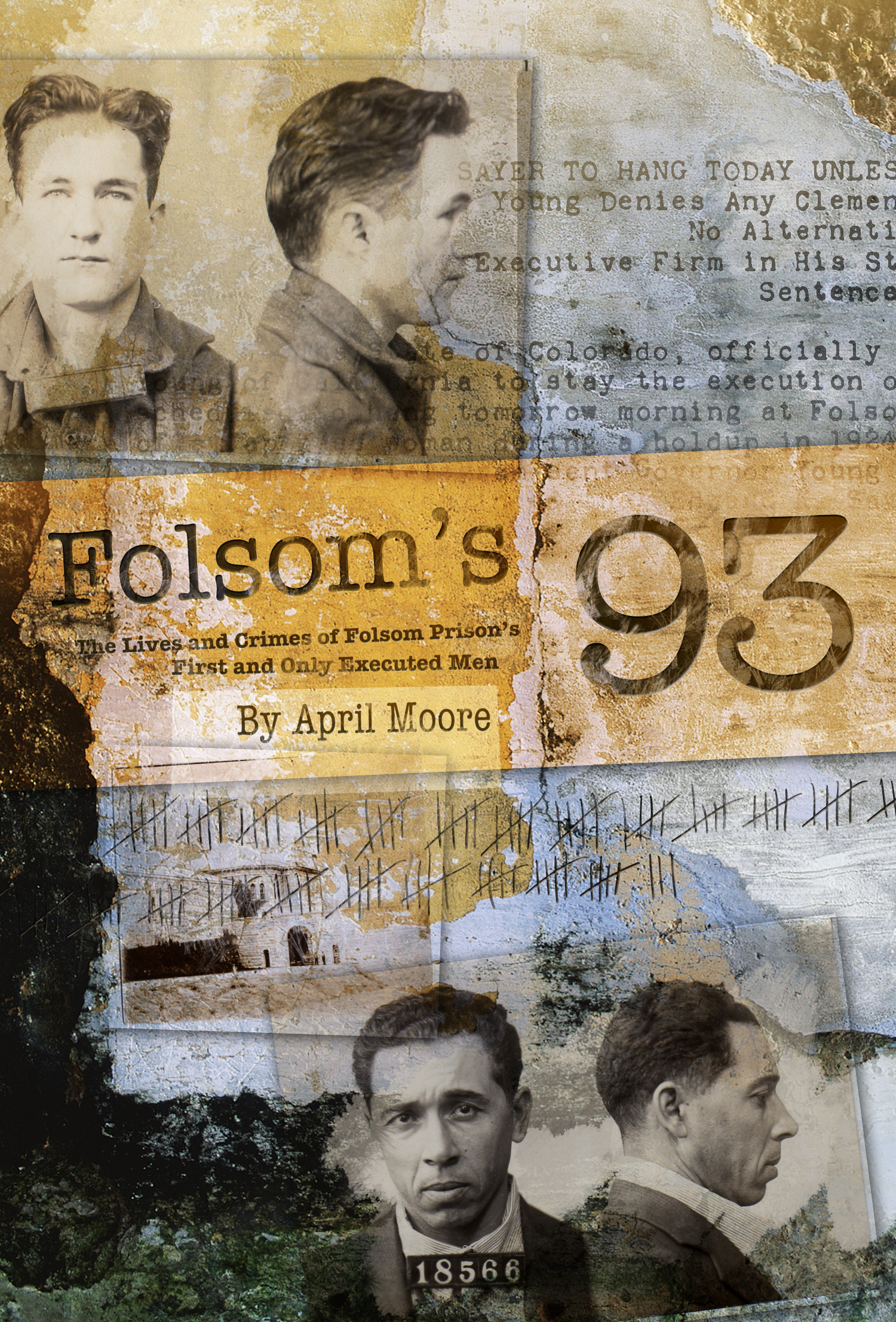
Folsom's 93

The Lives and Crimes of Folsom Prison's Executed Men


Leave a comment

Whiteboard Bliss

Until today, I thought my label maker was the next best thing to the invention of the wheel and a cure for polio, but then I discovered the pure elation of a whiteboard.

Now that I’m working with a publisher and have a deadline and word count to meet, I feel justified in buying this $30 whiteboard. (I had to hold myself back at the $50 magnetic one). I grew weary of writing down notes and outlines on pieces of paper because they often got lost, or I forgot which notebook I wrote them in. Not only did this dry-erase board simplify the paper chaos, but it’s mighty satisfying to use.

As I progress and as things change, I can erase, rewrite, erase, rewrite without using up paper—it’s brilliant. I can even pretend I’m Detective Kate Beckett from Castle; studying it, changing it, adding to it . . . (now I wish it was magnetic so could hang up some mugshots . . . dang it)!

ooh, look how pretty!


4 Comments

Let the (Prison) Show Begin

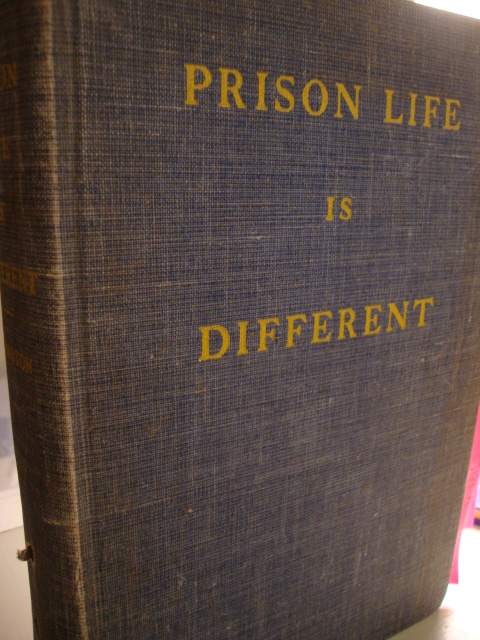
James A. Johnson became warden of Folsom in 1912. During his short stint at the prison, he made monumental changes to the penal system, including abolishing corporal punishment and bringing quality medical care to both mentally and physically sick inmates. Johnston chronicles his life as warden of San Quentin and Folsom in his book, Prison Life is Different, published in 1937. This book is a rare gem, giving the reader personal and insightful glimpses into California’s penal system in the early 1900s.

One task that Johnston found particularly engaging was overseeing a show, put on by convicts, to entertain their fellow inmates on the Fourth of July. This event soon became an annual show where boxing and bike races were also added. San Quentin inmates hosted their own annual vaudeville show that occurred every January. In fact, Folsom’s 27th execution, Edward Delehanty, was the director and manager of San Quentin’s show before he killed two fellow inmates, resulting in a transfer to Folsom. Delehanty, called “The Black Demon,” was considered immensely talented and took great pride in the yearly productions.

Well liked by the inmates, Johnston received an invitation to the Fourth of July show. He sat in the front row among the other prisoners. In his book, Johnston described the black face act as one of the big hits, where one performer, using big words, would confuse and bewilder his stage partner. “Finally, the smart one,” Johnston said, “simulating desperate impatience, walked his dumb partner down to the footlights and pulled this”:

‘Listen, you igmoramus, I already esplained the propolition six times and still you don’t comprehend, All my elucidation has failed to penetrate your obscuration. Now I’m gonna tell it to you once more. And boy I’m gonna make it clear. I’m gonna make it plain. I’m gonna make it simple. Now get ready. Pay retention. This am your last chance. If you don’t get it this time ther’s no hope for you. For believe me, boy, I’m gonna make it so plain an’ clear an’ so simple that even the officers and the guards will understand.’

One portion of the entertainment at Folsom included dressing up as women and performing comedic skits—one of the biggest draws of the show. I suppose when women are scarce, dressing up like one would have to do.


2 Comments

The Ink is (nearly) Dry

It looks like my book may finally have a home. I will be working with Linden Publishing/Craven Street Books to publish Folsom’s 93! Right now, the scheduled release date is spring of 2013, which gives me until next spring to have a finished manuscript. Plenty of time, right? Geez, I hope so. Wish me luck—I have a book to finish!


3 Comments

Why Back Matter Matters

First of all, you may be wondering what in the world is back matter. Well, it’s all the stuff following the main text of a book that usually consists of the index, epilogue, afterword, etc. I recently attended a workshop at the Northern Colorado Writers Association about back matter, taught by Natasha Wing, a children’s book author. Natasha routinely includes back matter in her books; anywhere from an activity or lesson, to maps or a glossary.

As I learned in the class, back matter is ideal for nonfiction, particularly, historical nonfiction like Folsom’s 93. In the course of researching for the book, I have accumulated nearly 900,000 words of notes. Obviously, it will need to be molded into a readable, coherent form of nonfiction, but what happens to the fascinating stuff that doesn’t make it into the book? If you’ve been a regular visitor to my site, you already know that I’ve shared many of these things on my blog. But there’s so much more.

I plan to have sidebars throughout the book, but that still is a fraction of what I have. I’d like to talk about Folsom’s cemetery, Folsom prison today, the Folsom Prison Museum, and the current status of the death penalty . . . to name a few.

Back matter consists of, but is not limited to: maps, bibliography, photographs, afterword, appendix/addendum, author notes, epilogue, acknowledgments, index, timeline, and glossary. These give the reader an opportunity to learn more about the subject matter and all in one place. It authenticates you as a researcher and as a professional; that you are an expert in your field. According to Wing, it also increases the value of the book, which is always a good thing.

I don’t know if I’ll be able to include everything that I’d like to in Folsom’s 93. So any leftover Folsom tales and tidbits will be found on my blog. No matter what you’re writing, keep everything! You never know when it can become back matter that matters.


6 Comments

A Ridiculous Understatement

On Tuesday, Timothy Masters, who spent nearly 10 years of a life sentence behind bars was finally exonerated for a 1987 murder he did not commit. Thanks to DNA testing (and a great deal of perseverance) he is a free man. This happened in the city in which I live. In regards to the case, District Attorney, Larry Abrahamson said, “America has the best criminal justice system in the world; however, no system is perfect.” Well there’s an understatement.

The best criminal justice system in the world?! We certainly have the largest, and most overcrowded. I read his quote in the paper this morning and I have thought about it all the day. Perhaps he was referring to the rights Americans have, in which case, I wholeheartedly agree. I love living in a country where its citizens cannot be persecuted for their religious, political and sexual preferences; that we have access to the law and the right to a trial, etc., but imperfection continues to run deep within this system.  So is it really the best in the world?

If we had the best criminal justice system in the world . . .

  • Prisons wouldn’t be at a 200% capacity
  • The U.S. Supreme Court wouldn’t have deemed California prisons as “cruel and unusual punishment,” a violation of the 8th Amendment
  • Inmates, both male and female, wouldn’t be getting raped everyday
  • The U.S. wouldn’t have the highest incarceration rate in the world
  • Prisons like Folsom wouldn’t have a 70% recidivism rate

If we had the best criminal justice system in the world . . .innocent people wouldn’t be executed. The list goes on and on.

Is the U.S. criminal justice system as good as its gets? Should I just shut up and appreciate we have what we have and accept these imperfections?

Quotes like this, especially from those in the field, merely shows the public that there is nothing wrong with the system—only that it’s not “perfect.” Until lawmakers start acknowledging the problems, our penal system will continue to be far from perfect.

You can read about Tim Masters and his case HERE.


Leave a comment

Stupid Criminals 1, by guest blogger, Jason Brick

I have the pleasure of bringing you my first guest blogger on Folsom’s 93. Jason Brick is a talented freelance writer and has recently published, Astoria: A Guide to Oregon’s Gate to the Sea. Visit Jason at his blog,brickcommajason to read about his latest projects as well as his great writing advice. Jason has also had experience in the parole and probation fields and has accumulated plenty of “stupid criminal stories” that are always worth passing along. I hope to bring  you several of Jason’s stories in the coming weeks. You can check out my guest post at Jason’s blog: Part 1 and Part 2 of staying on task as a work-from-home writer. Jason also works from home and juggles his career, family and being a ninja warrior. Seriously.

It was almost Christmas and Dan Droper (name changed to protect the guilty) was having a rough week. He’d been laid off, was within a month of foreclosure, and struggling with alcoholism. Worst yet, his wife had left him two nights earlier and he was staring down the barrel of a long weekend with nothing to do and nothing to distract him from his misery.

Dan gave in to temptation, made a collect call to his good pal Johnny Walker. Johnny brought his friends Jim and Jack. They had a party, but the good times turned into a maudlin drunk where the pain of losing his wife ached at Dan like the throbbing of a toothache.

The details of the next several hours don’t need repeating, but at the end of them Dan Droper was standing in the middle of his mother-in-law’s living room, holding a gun to his estranged wife’s head. Dahlia (name also changed) was the only one home, so nobody had called 911. There was no hostage situation, no negotiator outside with a megaphone. Just Don explaining that if she didn’t come back home, he’d end both of their lives right now.

Great Christmas present for his mother-in-law to find. Dahlia opted to go home with Dan. He made her drive to their — his — house. Marched her inside at the end of his gun. Once inside, he locked the door. He put his gun away in the bedroom closet. He cracked a beer, sat on the couch and turned on the TV. Dahlia stared at him and asked “What now?”

“Why don’t you get started on dinner?” Dan said.

Dahlia went into the kitchen and opened the fridge. Then she used the kitchen phone to call 911, and ran out the kitchen door.

Dan spent Christmas in the county lockup, and will be spending several of his next Christmases as a guest of the State.

Some folks are just too dumb for freedom.


Leave a comment

The Overpopulation of Prisons, Part IV: Conditions and Treatment

This is the fourth and final post in my series of articles concerning the grave and disturbing issue of overcrowded prisons. As I’ve mentioned before and you’ve likely heard it elsewhere, is that the U.S. Supreme Court deemed that the current California prison population violates the 8th Amendment, falling under “cruel and unusual punishment.”

Operating at a 200% capacity, the California penal system, one of the largest prison systems in country, is struggling to deal with the enormity of their predicament: How will they release 40,000 prisoners in two years? In the meantime, they’re facing a number of problems due to overcrowding with no relief in sight.

According to this article, California inmates are experiencing year-long waits for medical care and a suicide rate that is nearly twice the national average for prisoners. In fact, every 7-8 days, a prisoner commits suicide in California. Also disturbing is that there are fifty sick inmates at a time held in 12 by 20 foot cages for up to five hours as they await medical treatment.

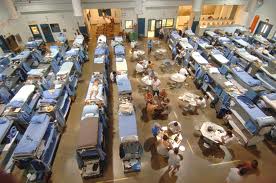
Gymnasiums and other areas designated for exercise and rehabilitation are now used to house 3-tiered bunk beds to accommodate the staggering numbers of inmates. Without the facilities to rehabilitate and educate prisoners, California prisons are creating a revolving door for which prisoners use to constantly reenter. They are not given the skills to become productive citizens once released. In fact, the National Center For Education Statistics, found that 7 out of 10 prisoners were either illiterate or functionally illiterate in 1992.

With the vast number of inmates, the waiting list for prison jobs is a mile long. Many of these jobs are considered “facility support services” that include kitchen duties, maintenance, and laundry jobs. With the recession hitting labor workers the hardest, it’s highly unlikely that these prisoners will find viable work outside of prison. The lack of work, coupled with the frustrations of living like a sardine, there has been a huge rise in prison violence toward one another and prison staff. Fights, riots, and rapes are reported daily.

With the emotional and psychological toll these conditions place on the average inmate, it’s no wonder they exhibit ignorance and apathy toward their situation. They experience violence, sickness (both mental and physical), abuse, and death everyday. And I’m not just talking about hardened criminals—even those serving their first time for relatively small infractions are subjected to these situations as well.

Any increase in funding has not kept up with increase in population. Basic needs are being ignored such as personal hygiene items, medical care, clean sheets and clothing, and bathing facilities. When items such as these become a hot commodity, you can bet there are those who take advantage of that by setting their own “prices” for them, oftentimes, in the form of sex.

While the U.S. “got tough” with crime and waged a war on drugs, little to no thought was designated to the consequences of these so-called good intentions. We wanted drugs and crime off of our streets, but prisons have become these efficient factories of those very things. And the solution is to release 40,000 inmates and hope that they learned enough to not come back to prison? I think what needs to change are what created the problem to begin with: mandatory sentencing, structured sentencing, 3 strikes law, and the war on drugs.

“I was in San Quentin and Soladad prisons. It’s no joke. the world passes you by. guy’s have never seen cell phones. I seen people who where in for violent acts in the 70’s with 5 to life that will never see day light except when they hit the yard because the state of California will not let violent inmates go even after serving 15 to 20 years with good time there’s so many inmates jobs are hard to get so you have to do your full sentence or go to school for your second GED and there’s always the violence just around the corner, the other side of the yard, two tables away in the dining hall. guards fucking with you. Trying to fuck your day up looking for you to make a mistake, even when your trying hard as you can not to do nothing wrong. Drama, Drama, Drama all day all night long day after day same shit different bowl.

–From a prisoner via InsidePrisons.com


Leave a comment

The Overpopulation of Prisons, Part III: Minorities

The numbers are truly staggering. As I’ve mentioned in Part I of this series, it is estimated that 1/3 of all black males in the United States will experience a stint in state prison at least once. Also, young black females are the fastest growing population in prison today.

The numbers have been rising for decades and they don’t seem to be slowing. According to the U.S. Bureau of Justice Statistics in 2009, non-Hispanic blacks account for 39.4% and Hispanics made up 20.6% of the jail and prison population.

These disparities between race and ethnicity garner several theories, and researchers who have examined the issue, determined that discrimination certainly plays a role—and not just with the arrest, but also occurring in the pretrial detention, prosecution, sentencing, and release decision-making. In fact, there is very little research available on racial bias in arrests.

In the 1980s and ’90s, minorities experienced the results of the war on drugs more than any other race. In 1999, blacks made up 46% of the sentenced prisoners for drug abuse in both state and federal jurisdiction. Interestingly, the difference in penalties for abusing crack cocaine (mostly used by blacks) and powder cocaine (mostly used by whites) contributed to more arrests and longer sentences for blacks. Federal law states that one gram of crack was equivalent to 100 grams of powder, thus resulting in longer sentences for the crack user.

In 2007, Hispanics made up 40% of federal offenders, a 24% increase from 1991. 48% of those were for immigration violations and 37% were drug offenses. Hispanics offenders are increasing rapidly and have violence rates that are higher than whites, but lower than that of blacks.

The Theories

Conflict Theory: Is said that the social economic forces in a society are the cause of crime; that criminal behavior is the consequence of the conflict which arises between competing groups within society; the haves vs. the have-nots.

Strain Theory: Based on the work of Robert Agnew in the 1930s and ’40s, this theory proposes that social structures in a society lead to deprivations and equality among its population, thus encourage those affected, to commit crime.

Social Disorganization Theory: Proponents of this theory accuse urban decay, or the breakdown of healthy urban communities to be the root of criminal behavior.

Macrostructural Opportunity Theory: Believes that the US is still widely residentially segregated. Proponents of this theory opine that if neighborhoods were more interracial, crime would be less prevalent.

Social Control Theory: This theory is considered one of the more popular theories. It proposes that those who commit crime, lack strong bonds with their social environment.

Subculture of Violence Theory: Anthropologist, Walter B. Miller suggested that the high of rate of crime among African Americans stems from a unique racial subculture that views violence in a different manner than the rest of mainstream America.

Because of the lack of studies and research pertaining to the growing numbers of incarcerated minorities, little is likely to be done to examine and remedy the issue. One blogger, who recently wrote about the same topic, made some logical suggestions:

Systemic problems such as lack of education, lack of community autonomy, and lack of resources, are clearly impacting  these statistics, as is the institution of racism. By putting more emphasis on success in school and programs for workforce development, and putting resources in these communities and in general breathing life and making whole these quite stagnant, at-risk living situations, we could give people the opportunity to break the cycle. Allowing returning citizens basic rights also seems democratic and just.


1 Comment

The Overpopulation of Prisons, Part II: Women in Prison

Not too long ago, according to my blog stats, someone had searched “hot women in prison” and surprisingly, came to Folsoms93.com (This was baffling, since I’ve never written anything about that before). Anyway, I’m sure the inquirer was hoping to find some salacious, not to mention unrealistic, portrayal of women having a great time with one another in prison. I’m assuming that this porn-surfer is completely oblivious to the actual conditions of women’s prisons. Now, I’m not speaking from experience, but from the amount of research I’ve done and from the words of actual female prisoners.

Give me a break!

Today, women are the fastest growing prison population, particularly African Americans. In 1999, the number of drug arrests for women were nearly twice as high than for men, yet twice as many men were arrested for violent crimes. Women are even arrested for simply living with a drug dealer, regardless of whether or not she was involved in the drug business. Sociologists have declared that the war on drugs, quickly translated to the war on women.

When lawmakers created structured sentencing, mandatory sentences, truth in sentencing and the three strikes law, their image of a criminal was a violent male predator, not a first time drug offending female. Many women prisoners, most who have no priors, commit non-violent crimes such as writing bad checks, shoplifting, and credit card fraud. These women often lack meaningful employment and are educational and economically deficient.

And we cannot forget that a vast majority of these women are mothers. Before the war on drugs, judges had the discretion to consider the woman’s crime, along with her family responsibilities, when it came to sentencing. That’s not the case now. According to the National Policy Committee’s 2001 report, almost half of incarcerated mothers have never received a visit from their children. This is due to the proximity of the prison to their homes. Many women’s prisons are located in rural areas and the average inmate’s home is a hundred miles from where they are incarcerated. What’s even more disturbing is that these children are five times more likely to commit crimes and become prisoners themselves.
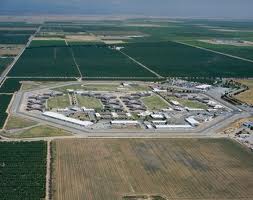
Central California’s Women’s Facility

Earlier this month, Laura Gottesdeiner’s article in the Huffington Post describes the horrible conditions in Central California’s Women’s Facility in Chowchilla. The prison houses nearly 3,700 inmates which is 180% capacity. Eight women are packed into a cell that is meant for only four. These prisons are designed, built and run by men.  Both former and current inmates report squalid conditions, lack of sanitary needs, and medical treatment is often unavailable or inconsistent. Across the country, these women tell their horrifying experiences of sexual abuse at the hands of the male guards. They are often raped by the guards, who also forced the women to have sex with maintenance workers, other prisoners, and even the prison chaplain. If the inmate becomes pregnant, she often forced to have an abortion.

According to Gottesdeiner’s article, California’s Department of Corrections and Rehabilitation began rationing supplies for basic needs such as toilet paper, soaps, and toothbrushes in an effort to relieve the painful swelling of the state budget. It has prompted some women inmates to resort to prostitution with guards in order to obtain these items.The Civil Rights Act of 1964, bars an employer from denying someone a job based on their sex, so male guards grossly outnumber their female counterparts.
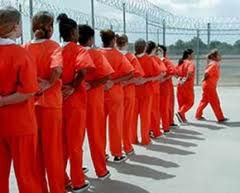
Women and Prison is a site dedicated to the lives of women incarcerated in the U.S. It is a venue developed in order for the public to hear the voices of both current and former women prisoners, who write about their experiences behind bars, many of which are emotionally difficult to read. Sara Olson, one such inmate wrote an article entitled, The Conditions in Women’s Prisons where she describes the mistreatment that runs rampant in California’s women’s prisons.

I want to make clear that I do believe criminals need to be dealt with, but accordingly. I think it’s ignorant to assume that all women (and male) prisoners have received sentences that fit their crimes. And even if they have, should they be denied their basic needs? Is it acceptable to cram them into cells that can barely accommodate them? Do they deserve to be sexually abused? The U.S. was highly criticized by it’s own citizens for the ill-treatment of foreign detainees at Guantanamo Bay, yet fellow Americans are being brutalized daily in both male and female prisons.

As lawmakers and voters, we need to alleviate this epidemic of abuse. Efforts need to be focused on addressing the problems that low-risk women offenders are faced with when it comes to sentencing. Until there are programs to educate and rehabilitate  prisoners, as well as programs to alleviate the economic strain on them, our prisons are going to continue to become broken down institutions of abuse and corruption.


Leave a comment

The Overpopulation of Prisons, Part I

Over the course of my research, I have stumbled upon a topic that we hear about all the time: Prison overpopulation. There are a number of contributing factors to this growing problem and so I thought I’d address them in a four-part series. In today’s post, I’d like to share some staggering facts about current prison population and how the “war on drugs” campaign has packed our prisons with inmates.


The United States has the highest incarceration rate in the world. Russia holds the number two spot. In 1980, there were less than 500,000 Americans in prison. Today, there are 1,404,503 people in state prisons, 208,118 in federal prison, and nearly 6 million on probation or parole. Today’s parole rate is a 59% increase since 1990.

Even with these numbers, crime is down 0.3%—the first drop since 1972. California has reported a 2.5% drop with 169,413 inmates. What’s behind the decrease? The state of California decided to cut the number of low-risk parolees who would return to prison because of technical parole violations. This move can be attributed to the state being ordered in 2009 to reduce its prison population by 30%. That’s 40,000 inmates. The state is struggling to meet such a demand.

Some facts:

The U.S. Department of Justice estimates that approximately 1/3 of all black males will experience state prison in their lifetime.

Young black women is the fastest growing prison population.

National spending on corrections in 1980: $9 billion. Today: $60 billion

Much of the increase of prison population can be blamed the on good intentions of the “War on Drugs.”  Forty years ago on June 17th, Nixon was the first to use that term. In 1980, 6% of the prison population consisted of drug offenders—about 19,000. In 1998, there were 237,000—21%. In 2008, there were over half a million people incarcerated for drug offenses, the result of 1.5 million drug-related arrests.

When  a politician decides to get “tough on crime,” it too, contributes to the overcrowding of prisons. Don’t get me wrong, I’m all about punishing those who commit crime, but those with no prior records are given mandatory sentences, or others who made a small infraction became victims of the “three strikes, you’re out,” law, thus, causing a swell in the already crowded prisons. This tough on crime has quickly become tough on prisons, as well as state and federal budgets. 

Other factors in the overcrowding of prisons consists of, “truth in sentencing” (abolishing parole—inmates serve their entire given sentence) and longer sentences for sex offenders.

In May 2011, The U.S. Supreme Court declared that the overcrowding in California state prisons is cruel and unusual punishment. As mentioned earlier, the state is struggling to figure out how to release 30,000 prisoners in the next 2 years. How will this happen? Governor Jerry Brown is suggesting moving non-violent and low-risk inmates to county jails, or even possibly out-of-state. Prison officials are practically on their hand and knees, asking for more funding to not only build more prisons, but to create educational programs that will reduce recidivism.

There are more factors involved in this ever-growing problem and in the coming days, I will talk about:

Women in prison—the fastest growing prison population

Conditions of prisons and its prisoners

Minorities in prison

Sources: National Policy Committee The Pew Center on the States The U.S. Dept of Justice